 Since 1823 the Allegory of the “Three Graces” was part many italian art works which went to enrich renowned British collections, as those who had the opportunity to see the original paintings respectfully admired what was ascertained to be the authentic work drawn by the hand of the great Raphael. But the principle of concealing proportions in paintings was probably misunderstood and unclear as demonstrated by the fact the formal principles of ancient art were still missing in the artistic foundations of the Early Renaissance.
In fact, within the painting reigns a great harmonic balance due to the recurring use of the “golden ratio”, along with its exquisite aesthetic beauty. Something that Raphael, at 24 and already rich in innate genius and artistic knowledge which he gathered from his studies of the marble statues from the Siena cathedral library, applied in the design and composition of the female figures of the Three Graces.
In 1497 in Milan, Luca Pacioli already described the concept in his studies “de divina proporzione” published in 1507 in Venice along with illustrations drawn by his close friend Leonardo, while also referring to Fibonacci and all ‘Albertio.
 The configuration of the human body into a system of proportions, measures and geometric shapes was also aspired to and illustrated beyond the Alps (Durer, Agrippa), as well as the idea that beauty can be represented by figures will remain in force (W.W.Story, Le Corbusier) to the present day with the golden number 1.6180339 …

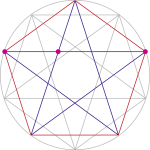 The pentagon is a symbol of harmony because the golden ratio originates from the diagonals forming the pentagram. Joined together in a circle they form a star with 10 branches or a double pentagram based on the principle of reduction or expansion of perfect proportions. A geometric structure of lines in which you can fit architectural constructions, human figures or shapes from nature, botany, geology and physics.
